Broncos Player Analysis: Round 13 Player Analysis and Round 14 Team Selection
Following each round of the NRL Premiership and Intrust Super Cup, each contracted Broncos player’s season-to-date performance is analysed and ranked against their internal competition.
This analysis process initially categorises players into four positional categories (with some players considered in multiple positional categories due to their perceived versatility):
- forwards;
- centres and wingers;
- halves and hooker; and
- fullback.
Once categorised, each player’s output in defined key performance indicators (KPIs) for their respective positional category is then considered, using data sourced from the NRL and QRL.
Different weightings are then assigned to the KPI data considered for each positional group based on the assumption that the cornerstones of the Broncos’ tactical approach is as follows:
- To have minimal missed tackles (<2 missed tackles per player per game) in all positional categories.
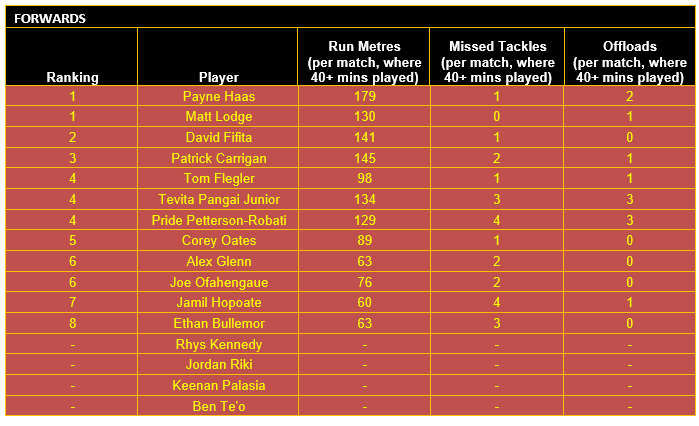
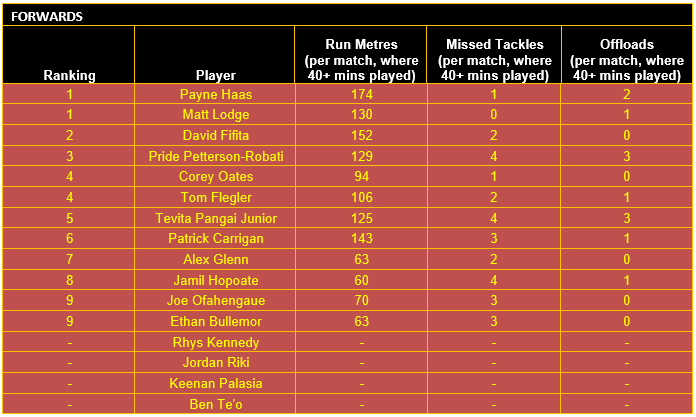
- To generate 100+ run metres and multiple offloads per game from each player in the forward positional group (to create second phase play for the halves, hooker and/or fullback to individually break the opposition’s defensive line or create line break opportunities for the centre and winger positional group).
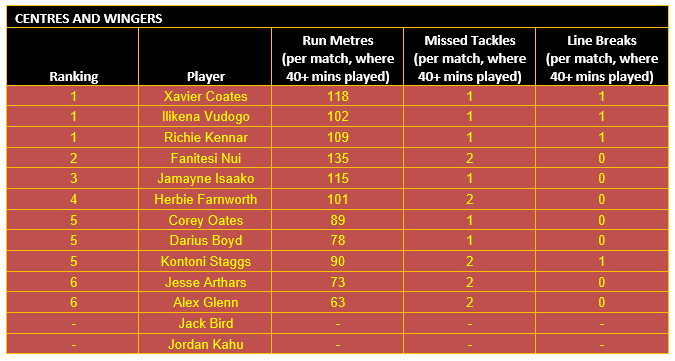
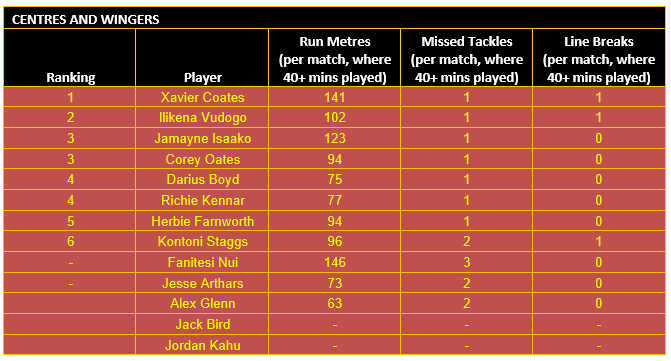
- To generate 100+ run metres and multiple line breaks per game from each player within the centre and wing positional group.
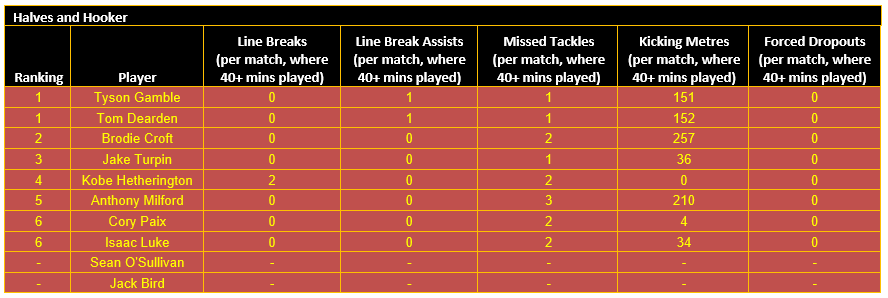
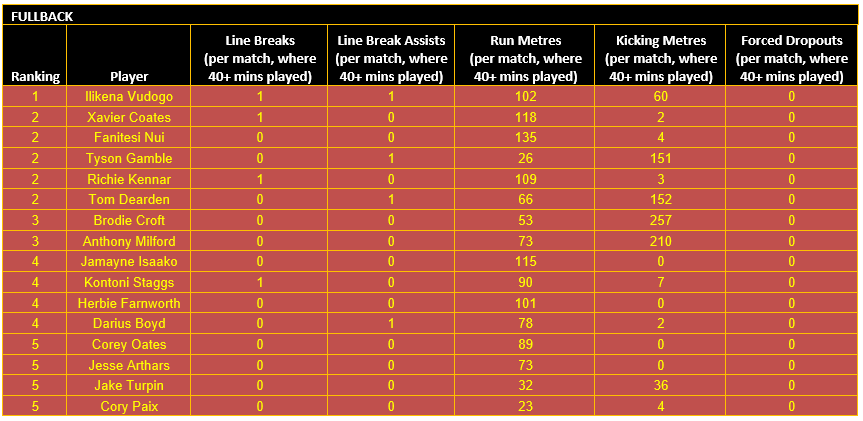
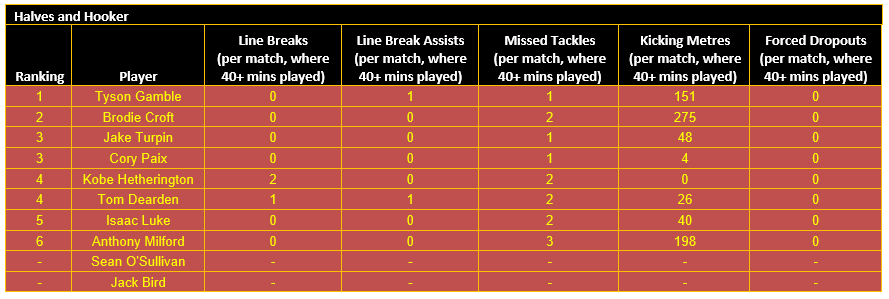
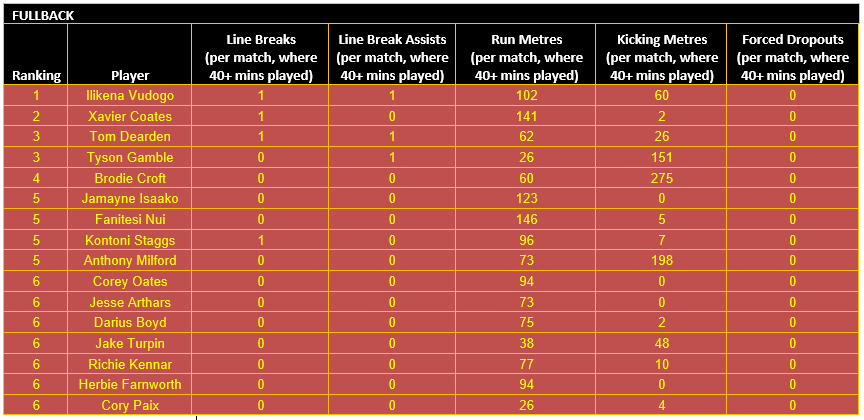
- To generate 100+ kicking metres and multiple line breaks, line break assists, and forced drop outs per game from each player in the halves and hooker and fullback positional groups.
The findings provide an invaluable insight as to:
- how each player ranks against their internal competition within their positional category; and
- which 17 players make up the Broncos’ most productive team.
Internal player rankings
Following Round 13 of the NRL and Round 1 of the Intrust Super Cup the player rankings are as follows:
Round 13 lineup
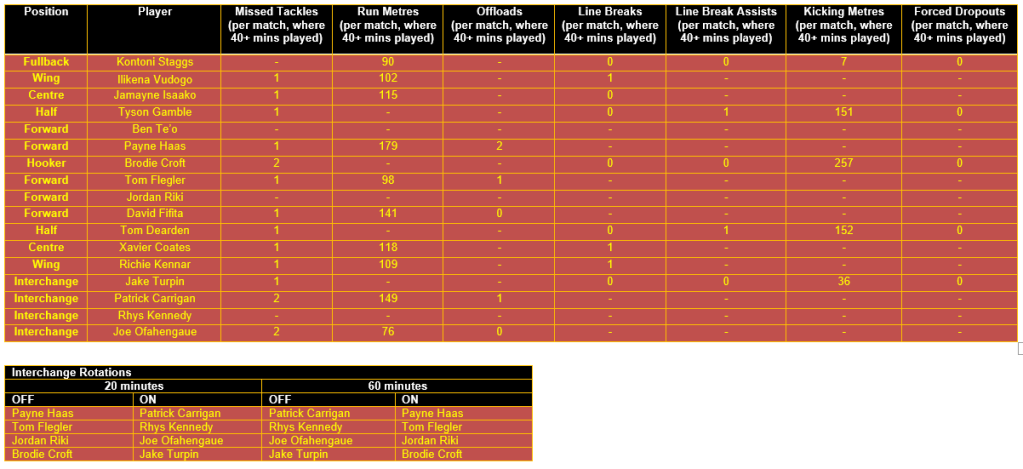
Based on the above analytical comparison, and with Palasia, Glenn, Oates, Lodge, O’Sullivan, Milford, Bird, Kahu, and Nui injured, and Pangai Jnr suspended, the 17 players which comprise the Broncos’ most productive team for their Round 14 clash versus the Canberra Raiders would appear to be as follows (with the proposed interchange rotations also outlined below):
Freddie08
Broncos Player Analysis: Round 12 Player Analysis and Round 13 Team Selection
Following each round of the NRL Premiership and Intrust Super Cup, each contracted Broncos player’s season-to-date performance is analysed and ranked against their internal competition.
This analysis process initially categorises players into four positional categories (with some players considered in multiple positional categories due to their perceived versatility):
- forwards;
- centres and wingers;
- halves and hooker; and
- fullback.
Once categorised, each player’s output in defined key performance indicators (KPIs) for their respective positional category is then considered, using data sourced from the NRL and QRL.
Different weightings are then assigned to the KPI data considered for each positional group based on the assumption that the cornerstones of the Broncos’ tactical approach is as follows:
- To have minimal missed tackles (<2 missed tackles per player per game) in all positional categories.
- To generate 100+ run metres and multiple offloads per game from each player in the forward positional group (to create second phase play for the halves, hooker and/or fullback to individually break the opposition’s defensive line or create line break opportunities for the centre and winger positional group).
- To generate 100+ run metres and multiple line breaks per game from each player within the centre and wing positional group.
- To generate 100+ kicking metres and multiple line breaks, line break assists, and forced drop outs per game from each player in the halves and hooker and fullback positional groups.
The findings provide an invaluable insight as to:
- how each player ranks against their internal competition within their positional category; and
- which 17 players make up the Broncos’ most productive team.
Internal player rankings
Following Round 12 of the NRL the player rankings are as follows:
Round 13 lineup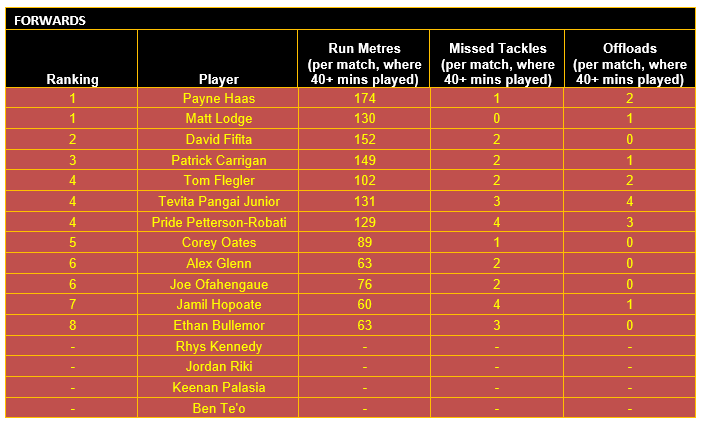
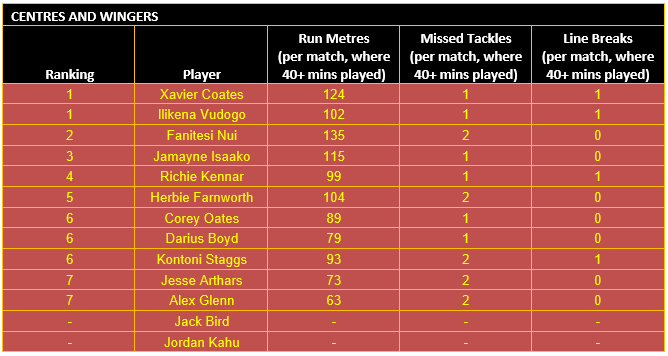
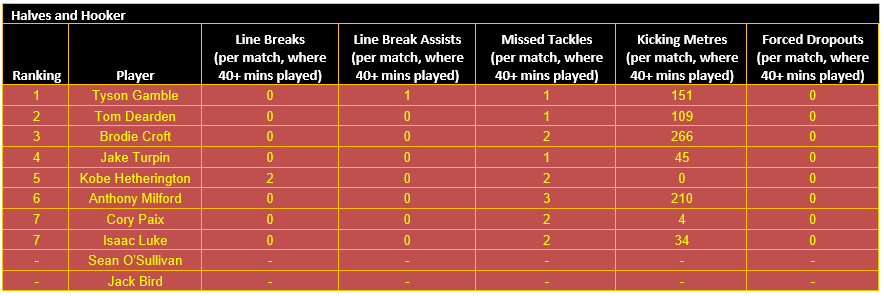
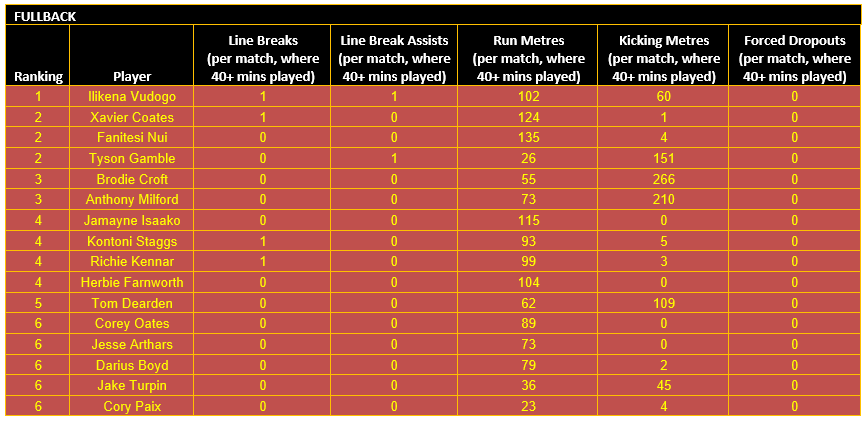
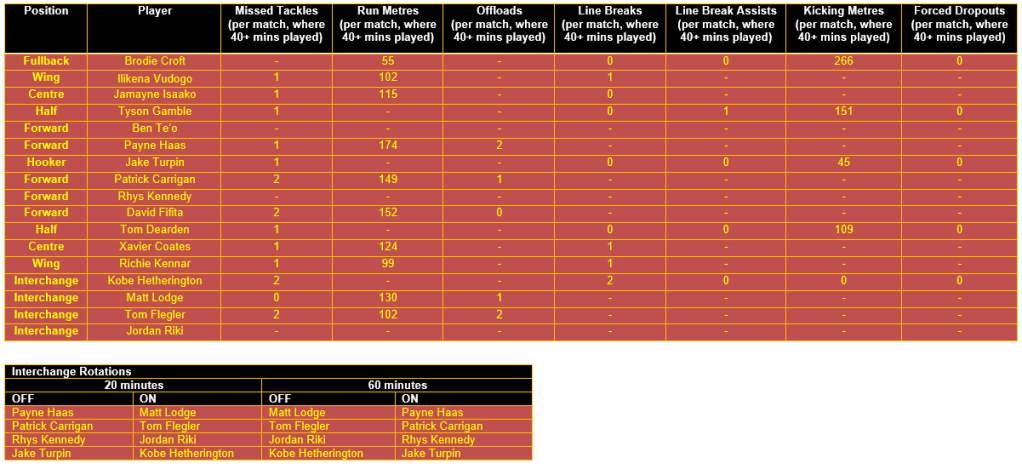
Based on the above analytical comparison, and with Palasia, Glenn, Oates, O’Sullivan, Milford, Bird, Kahu, and Nui injured, the 17 players which comprise the Broncos’ most productive team for their Round 13 clash versus the South Sydney would appear to be as follows (with the proposed interchange rotations also outlined below):
Freddie08
Broncos Player Analysis: Round 11 Player Analysis and Round 12 Team Selection
Following each round of the NRL Premiership and Intrust Super Cup, each contracted Broncos player’s season-to-date performance is analysed and ranked against their internal competition.
This analysis process initially categorises players into four positional categories (with some players considered in multiple positional categories due to their perceived versatility):
- forwards;
- centres and wingers;
- halves and hooker; and
- fullback.
Once categorised, each player’s output in defined key performance indicators (KPIs) for their respective positional category is then considered, using data sourced from the NRL and QRL.
Different weightings are then assigned to the KPI data considered for each positional group based on the assumption that the cornerstones of the Broncos’ tactical approach is as follows:
- To have minimal missed tackles (<2 missed tackles per player per game) in all positional categories.
- To generate 100+ run metres and multiple offloads per game from each player in the forward positional group (to create second phase play for the halves, hooker and/or fullback to individually break the opposition’s defensive line or create line break opportunities for the centre and winger positional group).
- To generate 100+ run metres and multiple line breaks per game from each player within the centre and wing positional group.
- To generate 100+ kicking metres and multiple line breaks, line break assists, and forced drop outs per game from each player in the halves and hooker and fullback positional groups.
The findings provide an invaluable insight as to:
- how each player ranks against their internal competition within their positional category; and
- which 17 players make up the Broncos’ most productive team.
Internal player rankings
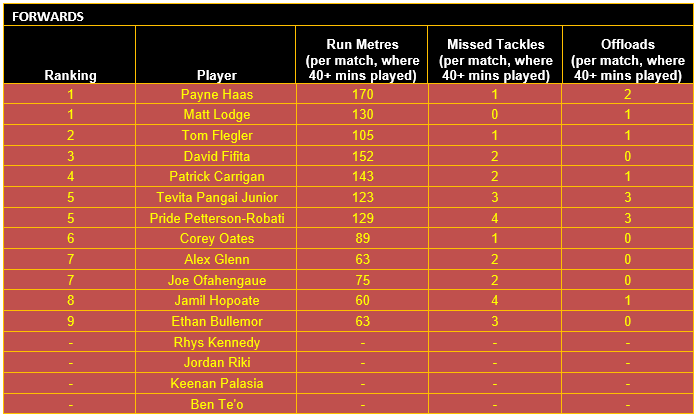
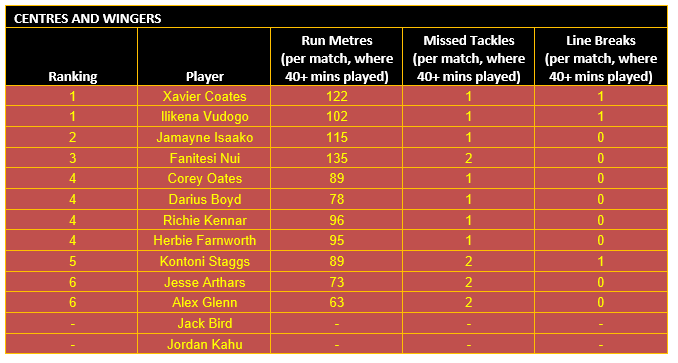
Following Round 11 of the NRL the player rankings are as follows:
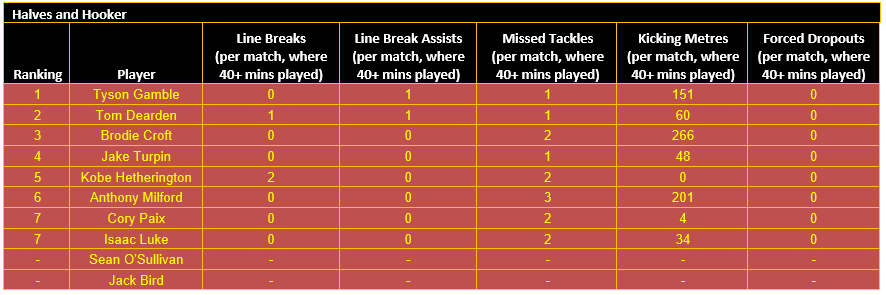
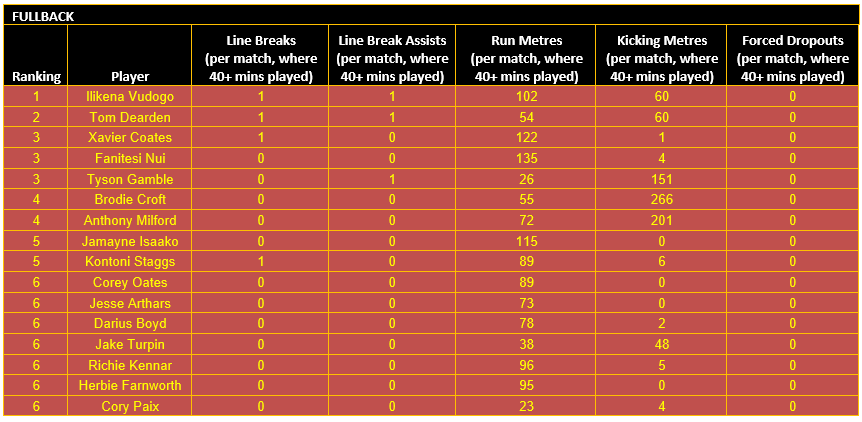
Round 12 lineup
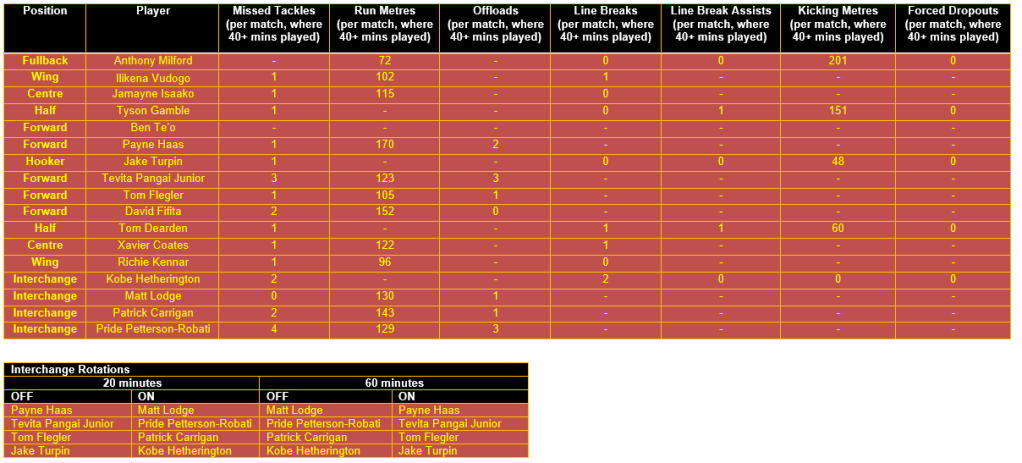
Based on the above analytical comparison, and with Palasia, Glenn, Oates, O’Sullivan, Bird, Kahu, and Nui injured, the 17 players which comprise the Broncos’ most productive team for their Round 12 clash versus the Cronulla Sharks would appear to be as follows (with the proposed interchange rotations also outlined below):
Freddie08
Broncos Player Analysis: Round 10 Player Analysis and Round 11 Team Selection
Following each round of the NRL Premiership and Intrust Super Cup, each contracted Broncos player’s season-to-date performance is analysed and ranked against their internal competition.
This analysis process initially categorises players into four positional categories (with some players considered in multiple positional categories due to their perceived versatility):
- forwards;
- centres and wingers;
- halves and hooker; and
- fullback.
Once categorised, each player’s output in defined key performance indicators (KPIs) for their respective positional category is then considered, using data sourced from the NRL and QRL.
Different weightings are then assigned to the KPI data considered for each positional group based on the assumption that the cornerstones of the Broncos’ tactical approach is as follows:
- To have minimal missed tackles (<2 missed tackles per player per game) in all positional categories.
- To generate 100+ run metres and multiple offloads per game from each player in the forward positional group (to create second phase play for the halves, hooker and/or fullback to individually break the opposition’s defensive line or create line break opportunities for the centre and winger positional group).
- To generate 100+ run metres and multiple line breaks per game from each player within the centre and wing positional group.
- To generate 100+ kicking metres and multiple line breaks, line break assists, and forced drop outs per game from each player in the halves and hooker and fullback positional groups.
The findings provide an invaluable insight as to:
- how each player ranks against their internal competition within their positional category; and
- which 17 players make up the Broncos’ most productive team.
Internal player rankings
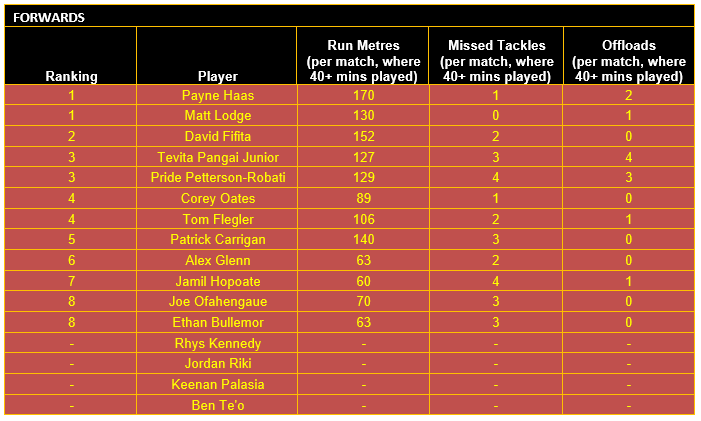
Following Round 10 of the NRL the player rankings are as follows:
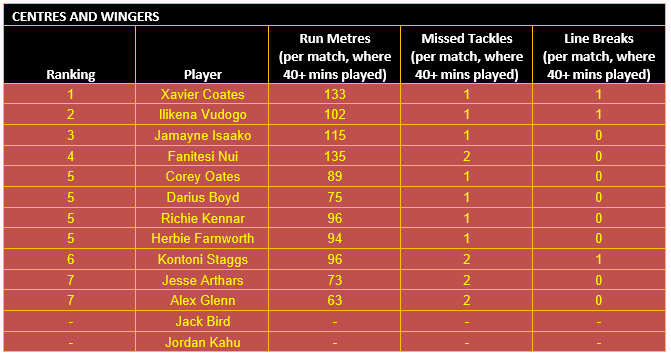
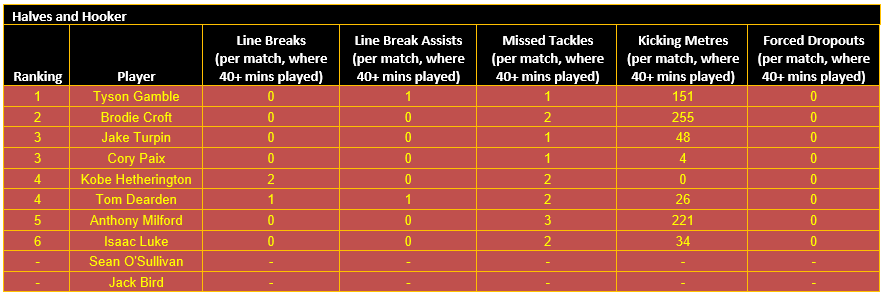
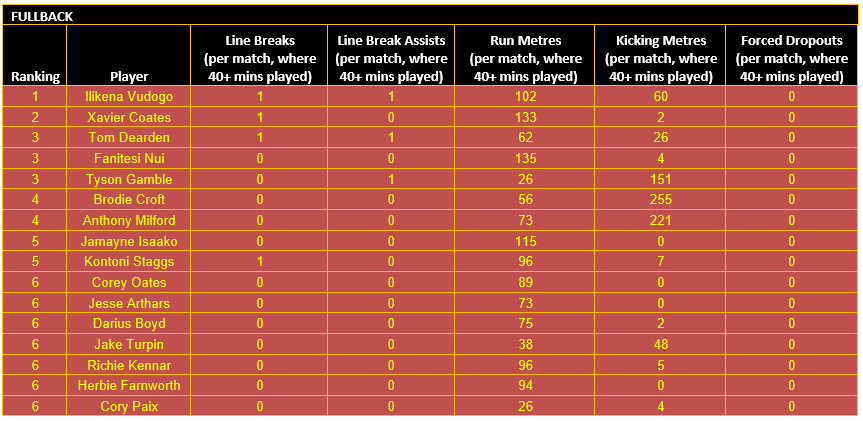
Round 11 lineup
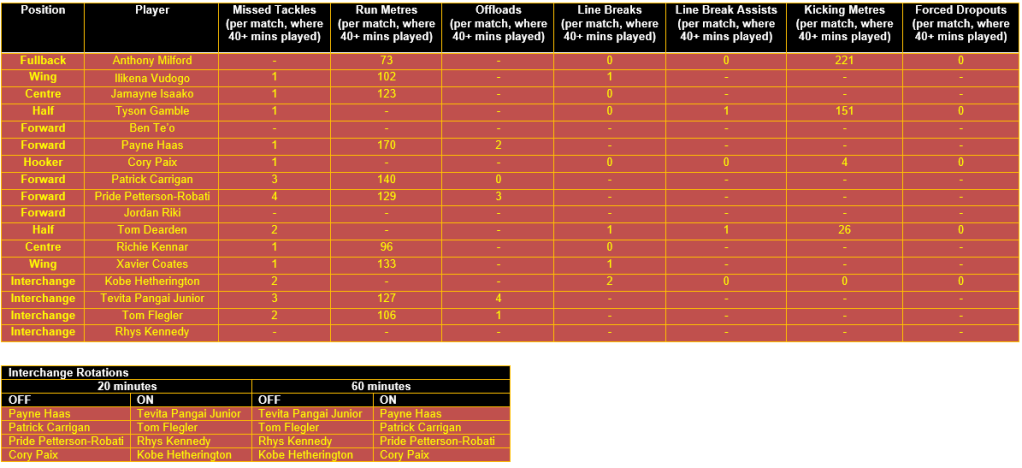
Based on the above analytical comparison, and with Palasia, Lodge, Fifita, Glenn, Oates, Turpin, O’Sullivan, Bird, Kahu, Staggs, Nui, and Arthars injured, and Luke suspended the 17 players which comprise the Broncos’ most productive team for their Round 11 clash versus the Melbourne Storm would appear to be as follows (with the proposed interchange rotations also outlined below):
Freddie08
Broncos Player Analysis: Round 9 Player Analysis and Round 10 Team Selection
Following each round of the NRL Premiership and Intrust Super Cup, each contracted Broncos player’s season-to-date performance is analysed and ranked against their internal competition.
This analysis process initially categorises players into four positional categories (with some players considered in multiple positional categories due to their perceived versatility):
- forwards;
- centres and wingers;
- halves and hooker; and
- fullback.
Once categorised, each player’s output in defined key performance indicators (KPIs) for their respective positional category is then considered, using data sourced from the NRL and QRL.
Different weightings are then assigned to the KPI data considered for each positional group based on the assumption that the cornerstones of the Broncos’ tactical approach is as follows:
- To have minimal missed tackles (<2 missed tackles per player per game) in all positional categories.
- To generate 100+ run metres and multiple offloads per game from each player in the forward positional group (to create second phase play for the halves, hooker and/or fullback to individually break the opposition’s defensive line or create line break opportunities for the centre and winger positional group).
- To generate 100+ run metres and multiple line breaks per game from each player within the centre and wing positional group.
- To generate 100+ kicking metres and multiple line breaks, line break assists, and forced drop outs per game from each player in the halves and hooker and fullback positional groups.
The findings provide an invaluable insight as to:
- how each player ranks against their internal competition within their positional category; and
- which 17 players make up the Broncos’ most productive team.
Internal player rankings
Following Round 9 of the NRL the player rankings are as follows:
Round 10 lineup
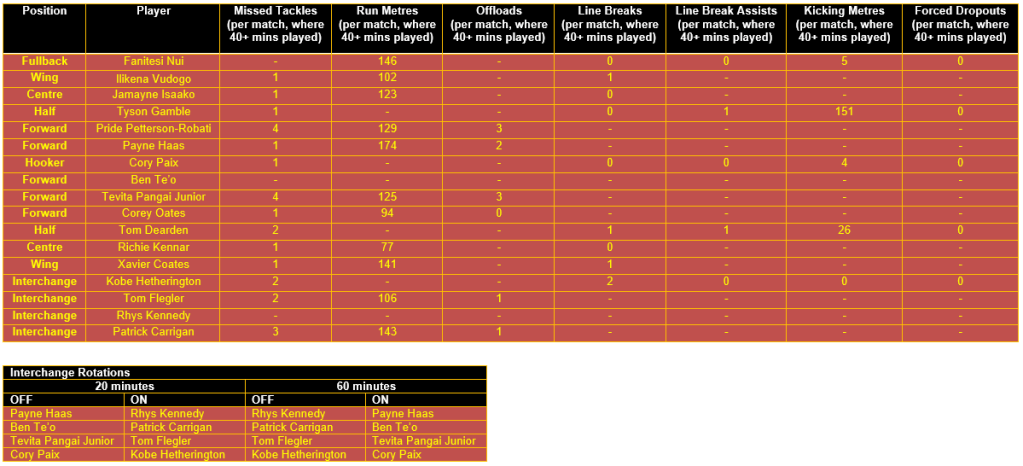
Based on the above analytical comparison, and with Palasia, Lodge, Fifita, Turpin, O’Sullivan, Bird, Kahu, Staggs, Arthars, and Farnworth injured, the 17 players which comprise the Broncos’ most productive team for their Round 10 clash versus the West Tigers would appear to be as follows (with the proposed interchange rotations also outlined below):
Freddie08
Broncos Player Analysis: Round 8 Player Analysis and Round 9 Team Selection
Following each round of the NRL Premiership and Intrust Super Cup, each contracted Broncos player’s season-to-date performance is analysed and ranked against their internal competition.
This analysis process initially categorises players into four positional categories (with some players considered in multiple positional categories due to their perceived versatility):
- forwards;
- centres and wingers;
- halves and hooker; and
- fullback.
Once categorised, each player’s output in defined key performance indicators (KPIs) for their respective positional category is then considered, using data sourced from the NRL and QRL.
Different weightings are then assigned to the KPI data considered for each positional group based on the assumption that the cornerstones of the Broncos’ tactical approach is as follows:
- To have minimal missed tackles (<2 missed tackles per player per game) in all positional categories.
- To generate 100+ run metres and multiple offloads per game from each player in the forward positional group (to create second phase play for the halves, hooker and/or fullback to individually break the opposition’s defensive line or create line break opportunities for the centre and winger positional group).
- To generate 100+ run metres and multiple line breaks per game from each player within the centre and wing positional group.
- To generate 100+ kicking metres and multiple line breaks, line break assists, and forced drop outs per game from each player in the halves and hooker and fullback positional groups.
The findings provide an invaluable insight as to:
- how each player ranks against their internal competition within their positional category; and
- which 17 players make up the Broncos’ most productive team.
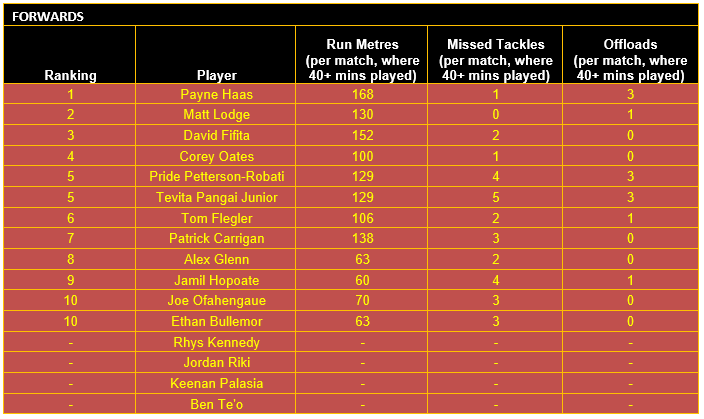
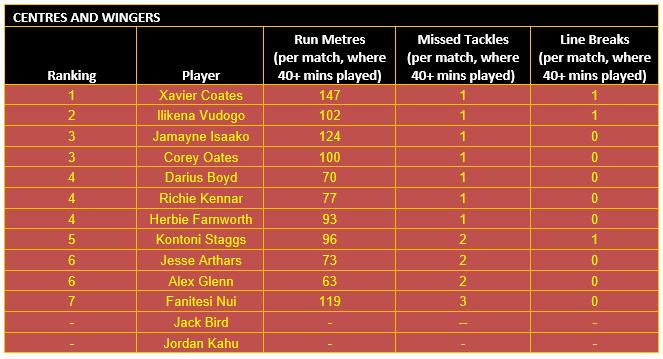
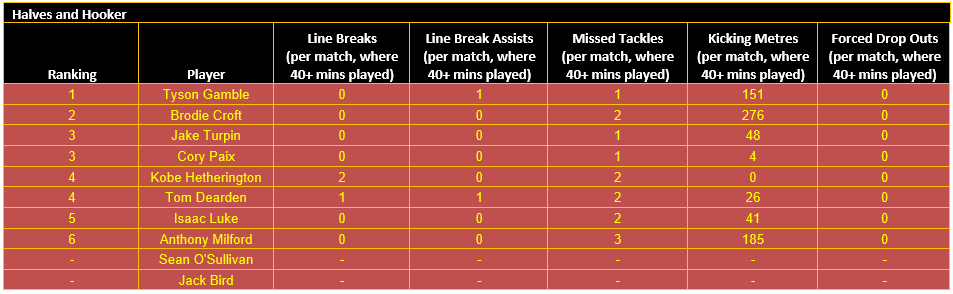
Internal player rankings
Following Round 8 of the NRL the player rankings are as follows:

Round 9 lineup
Based on the above analytical comparison, and with Palasia, Bird, Kahu, and O’Sullivan injured, and Ofahengaue suspended, the 17 players which comprise the Broncos’ most productive team for their Round 9 clash versus the Canterbury Bulldogs would appear to be as follows (with the proposed interchange rotations also outlined below):
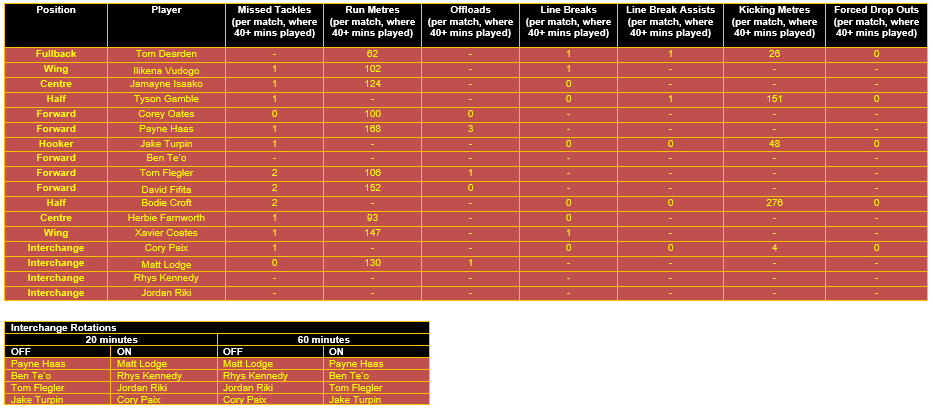
Freddie08
Broncos Player Analysis: Round 1 Player Analysis and Round 2 Team Selection
Following each round of the NRL Premiership and Intrust Super Cup, each contracted Broncos player’s season-to-date performance is analysed and ranked against their internal competition.
This analysis process initially categorises players into four positional categories (with some players considered in multiple positional categories due to their perceived versatility):
- forwards;
- centres and wingers;
- halves and hooker; and
- fullback.
Once categorised, each player’s output in defined key performance indicators (KPIs) for their respective positional category is then considered, using data sourced from the NRL and QRL.
Different weightings are then assigned to the KPI data considered for each positional group based on the assumption that the cornerstones of the Broncos’ tactical approach is as follows:
- To have minimal missed tackles (<2 missed tackles per player per game) in all positional categories.
- To generate 100+ run metres and multiple offloads per game from each player in the forward positional group (to create second phase play for the halves, hooker and/or fullback to individually break the opposition’s defensive line or create line break opportunities for the centre and winger positional group).
- To generate 100+ run metres and multiple line breaks per game from each player within the centre and wing positional group.
- To generate 100+ kicking metres and multiple line breaks, line break assists, and forced drop outs per game from each player in the halves and hooker and fullback positional groups.
The findings provide an invaluable insight as to:
- how each player ranks against their internal competition within their positional category; and
- which 17 players make up the Broncos’ most productive team.
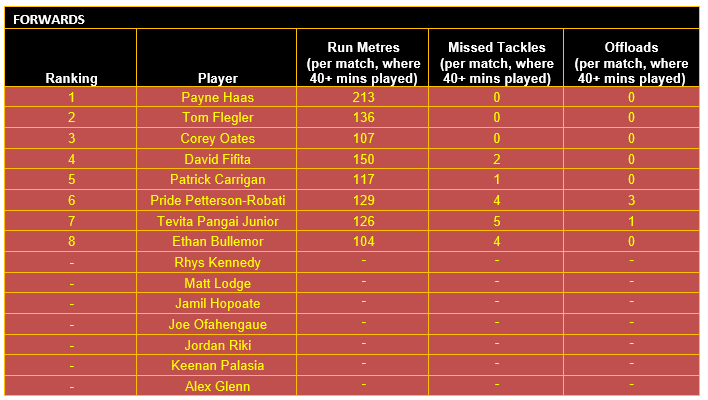
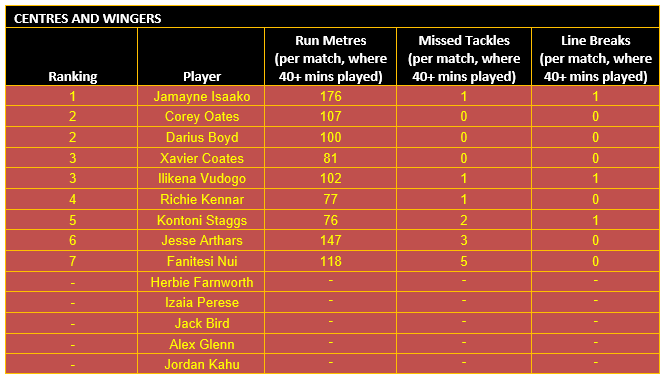
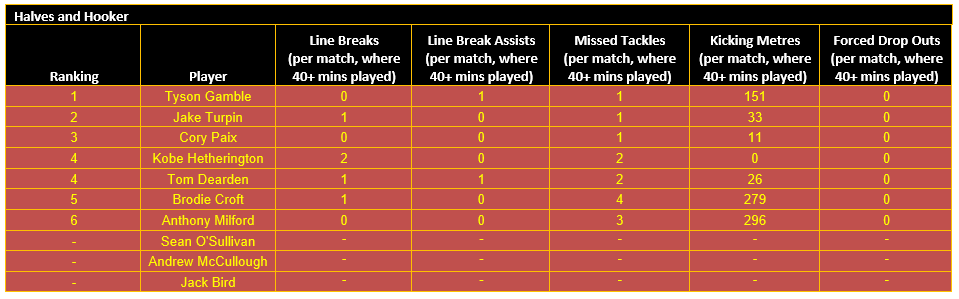
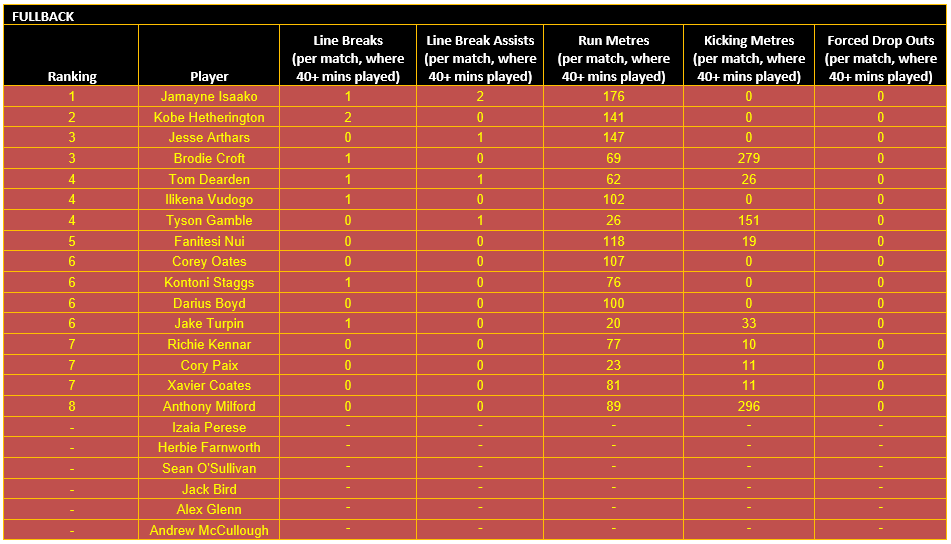
Internal player rankings
Following Round 1 of the NRL and Round 1 of the Intrust Super Cup, the player rankings are as follows:
Round 2lineup
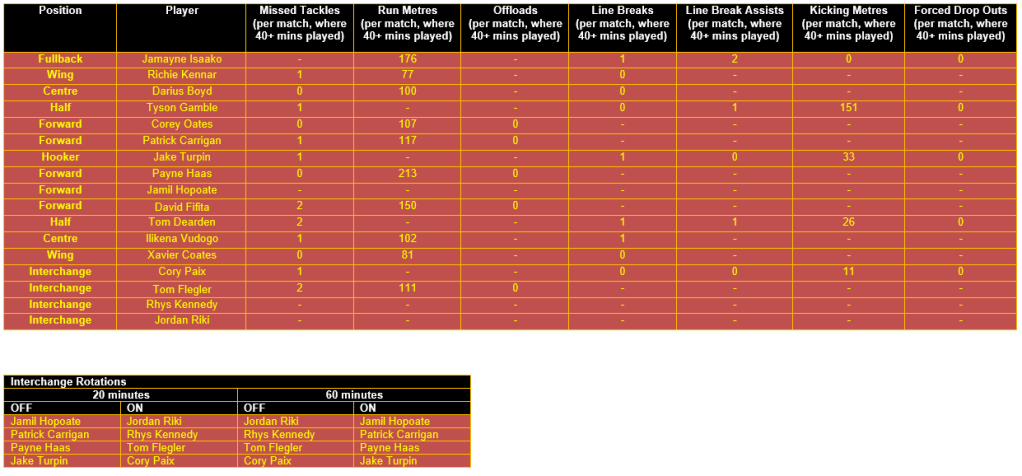
Based on the above analytical comparison, and with Lodge, Palasia, Glenn, Bird, Kahu, and O’Sullivan injured, and Ofahengaue, Pangai Junior, and Perese suspended, the 17 players which comprise the Broncos’ most productive team for their Round 2 clash versus the South Sydney Rabbitohs would appear to be as follows (with the proposed interchange rotations also outlined below):
Freddie08
Broncos continue to recruit based on name rather than productivity as Croft signs on
In another seemingly questionable recruitment decision, the Broncos have announced the signing of half and hooking option Brodie Croft (25) on a three year deal.
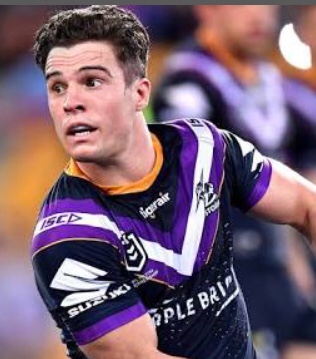
While the lack of productivity in the Broncos’ halves and hooking options, was a vexed issue for the Broncos in the 2019 season, investing significant money in signing Croft, whose on field production last season (0 line breaks, 0 line break assists, 3 missed tackles, 185 kicking metres and 0 forced drop outs per match) would have ranked him sixth amongst the club’s halves and hooking options, does not appear to be the answer.
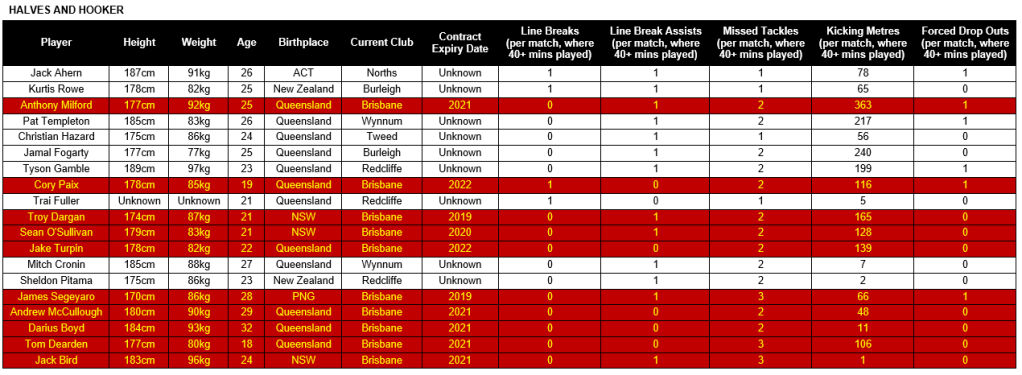
2019 productivity data – halves and hooker
With highly productive alternative options such as Jack Ahern, Kurtis Rowe, Pat Templeton, Christian Hazard and Jamal Fogarty, yet to sign for an NRL club in 2020, it appears once again, that the Broncos have recruited Croft, based on his name, rather than his on field performances. A dangerous recruitment strategy.
Freddie08
Inept recruitment decisions continue as Shibasaki is released but Staggs is resigned
In a surprise decision, the Broncos have announced the immediate departure of centre, wing and fullback option Gehamat Shibasaki to the Newcastle Knights and the re-signing of fellow centre, wing and fullback option Kontoni Staggs.
At the conclusion of the 2019 season, Shibasaki was ranked as the 10th most productive fullback option, and 7th most productive centre or winger option at the club. In contrast, Staggs ranked as the 15th most productive fullback option, and 11th most productive centre or winger option at the club
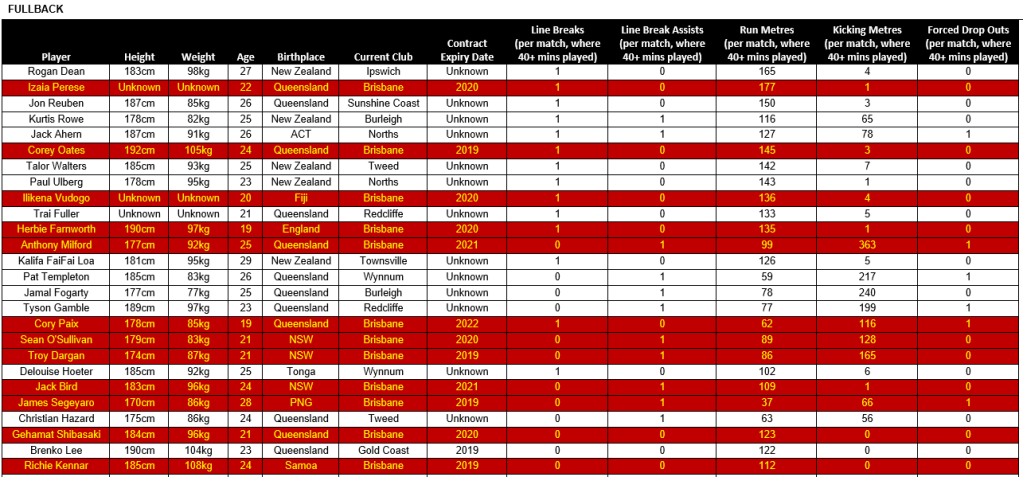

2019 productivity data – fullbacks
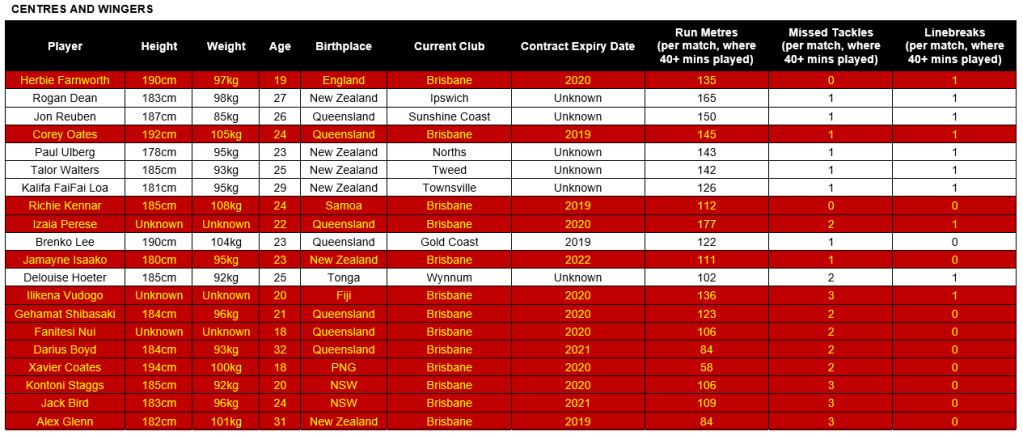
2019 productivity data – centres and wingers
While the Broncos’ decision to cut ties with Shibasaki should have freed up salary cap space to help re-sign to a longer term deal, a more productive player such as Farnworth, Hopoate, Kennar, Perese, or Vudogo, the club’s decision to sacrifice Shibasaski, and seemingly use the cap savings to re-sign a substantially less productive and more defensively liable player in Staggs, is totally baffling.
It is another disappointing moment for the Broncos’ recruitment and retention team.
Obviously, salary cap restraints mean the Broncos can’t retain all players. That said, the consistently inferior on field performances in recent seasons from regular first graders Staggs, Alex Glenn, Jack Bird, Andrew McCullough, Darius Boyd, and Xavier Coates, means the Broncos should have first sought to move on a number of those players, before contemplating releasing the likes of Shibasaki.
Freddie08
Broncos sign Arthars
In recruitment news, the Broncos have announced the signing of centre/wing and fullback option Jesse Arthar (21) on a two year deal.
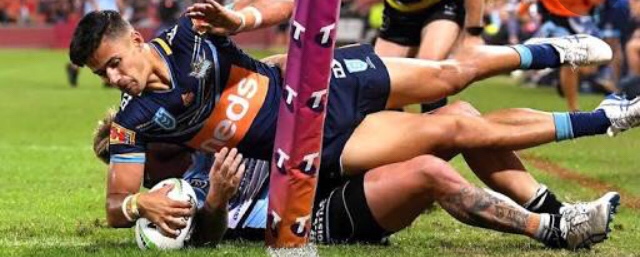
With a host of young outside backs already on the Broncos books (e.g. Shibasaki, Kennan, Perese, Vudogo, Staggs, Issako, Farnworth, Nui) and all of those players substantially outperforming Arthars’ 80 metres per match contribution last season, it is somewhat perplexing that the Broncos have wasted precious salary cap space on signing Arthars.
2019 productivity data – fullbacks
2019 productivity data – centres and wingers
Arthars signing is yet another example of the lack of ruthlessness in the Broncos’ recruitment practices. One can only hope the Broncos don’t consequential lose one of their more productive young outside backs as a result of Arthars’ arrival.
Freddie08
 My Brisbane Broncos